
Hey First Coffee Then ABA Family I am super excited to share this new intervention with you!! This intervention is one that I use in my own home, but I have also used in school and therapy settings. I like to call this intervention “Offer Choices You Can Live With”. How many of you, like me, have told your child you have to do this right now, and when you do, your child immediately says no, has a tantrum, and refuses to do what you have said? Well, this might be the intervention for you!!! Let me give an example of what I mean. Instead of telling your child, “You have to brush your teeth right now.” You could say, “You can either brush your teeth before or after you put your pajamas on.” You have given your child choices that you can live with as he/she is still going to brush his/her teeth, but your child is less likely to become “oppositional” because he/she has choices as to when to brush his/her teeth. When your child feels like he/she doesn’t have any “control” over what he/she does or when he/she does it, your child is more likely to become “oppositional” and engage in problem behavior. Children feel empowered when they are given choices which reduces the likelihood that they will engage in problem behavior. Here are a few keys to success when giving choices: 1. Don’t give too many choices. Too many choices can create anxiety in a child which can also cause problem behavior to occur. 2. Be sure that you can live with either choice. Don’t give choices that will create frustration in you as your child will see that and might cause some problem behavior to occur. 3. Finally, be sure that your child follows through on the choice that was made. Allowing your child to escape from the task can reinforce escaping from the task and increase problem behavior. If implemented correctly, “Offering choices that you can live with” can really be a beneficial intervention to use with your child. I hope that you find this intervention useful in your home or professional practice. Please continue to share this page so that this information can help as many families and professionals as possible!!! Thank you all for your support!!! With Love Kimberly W
Author: firstcoffeethenaba
Building Compliance Series (Entry 3)
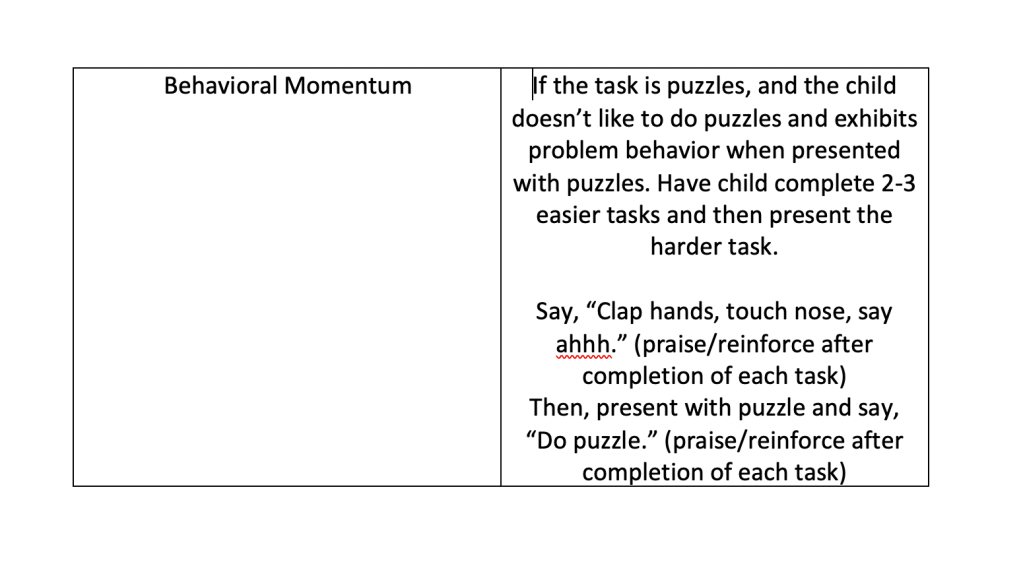
Hello First Coffee Then ABA Family!!!! I am super excited to share one of my favorite behavior compliance interventions!!! I have used this intervention so much!! I have used it with very young children as well as middle and high school children!! This intervention is very effective no matter the level of functioning!!! This intervention is called behavioral momentum!! I know…the name sounds big and scary, but I promise it is easy peasy!!! So, what in the world is behavioral momentum you ask? Well, it is a fancy term for having a child complete easier, more preferred tasks prior to asking them to do a harder, less preferred task that they are likely to try to escape from. So, let me give you an example. If your child or student does not like to do puzzles and tries to escape from doing puzzles every time you present them, then you could have them perform 2-3 easy, previously mastered, or more preferred tasks prior to asking him/her to put in a puzzle piece. So, I might ask my child to clap hands, touch nose, say “ahhh”, then ask my child to put the puzzle piece in. So, you might ask, why or how does this work? Well, you are using the momentum that they have built up while being successful at completing the easier tasks to keep them going to complete the harder task. You might have to do this for every puzzle piece, or the child might be able to complete several puzzle pieces before needing to build up momentum again. Be sure that you are praising the child and providing reinforcement for doing the easier tasks and also for completing each part the harder task. Providing the praise or another type of reinforcement for completing the tasks helps the child build the momentum and helps prevent the child from exhibiting problem behavior and trying to escape from the harder task. Behavioral momentum really is that simple, and it really does work!! Here are a few keys to success: make sure the tasks that you ask the child to do before the harder task really are easier skills for the child, make it fun and be excited, the easier tasks should also be quick, be sure to praise and/or reinforce the child for completing the tasks, and be willing to let the child build momentum again if needed to complete the task. The more successful the child is with the harder task; the more willing the child will be to engage in that task without exhibiting problem behavior in the future!!! I hope that you find this intervention useful for child/student/client!!! Don’t forget to share our page so that we can help as many families and professionals as possible!!! When we reach 100 likes, I will be giving away 2 gift cards!!! With Love, Kimberly W.
Building Compliance Series (entry 2)
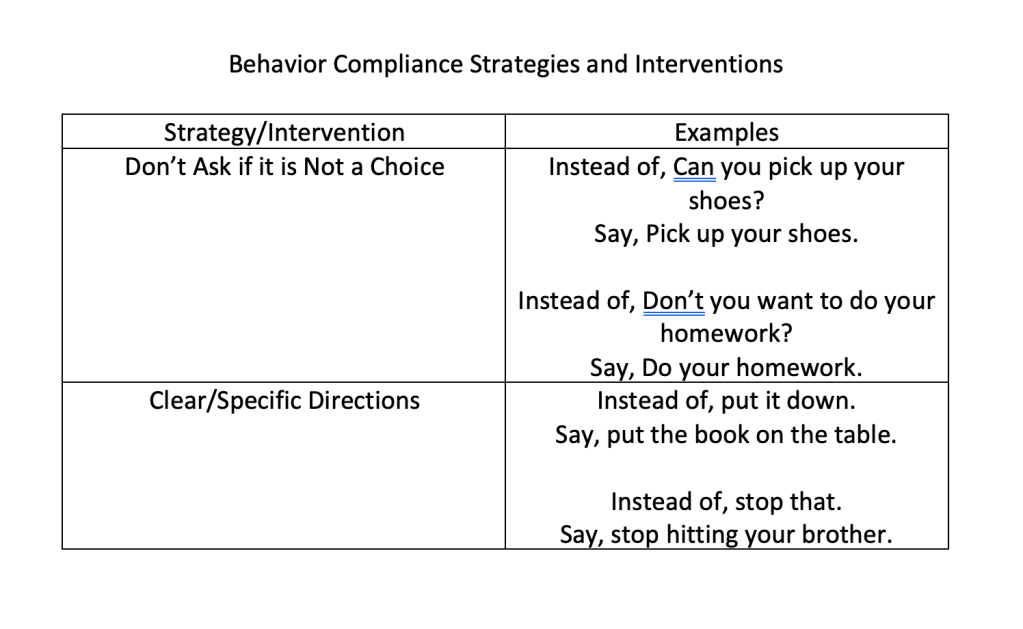
Hey First Coffee Then ABA followers, first, I want to apologize for the disruption in our weekly posts!!! I have been experiencing computer issues for a while and had to get a new one. Our wifi is so terrible that it took many days to download everything and move it to the new one. So, without further delay, let’s keep this series going!!! Tonight, we are going to talk about 2 simple but effective strategies to use with your child. I call the first of these strategies “Don’t Ask if it is not a Choice.” I know this sounds silly, but we do it without even noticing. I have caught myself saying, “Can you please pick up that towel?” When what I should be saying is, “Pick up that towel.” My teenager seems to never be able to get his towel back to the bathroom and hung up unless prompted…lol. If you ask a demand in a question format, it can seem like the child has a choice whether to comply, when it is not a choice. So, instead of presenting the demand in question format, you should give it in a “command” statement. Next, let’s talk about another easy strategy. I like to call this one Clear/Specific Directions. There are so many times as a parent that I have said things like, “Stop that, put that down, etc.”, and my kids will think that they have done what I told them to do. Then, I realize they might have done part of what I told them to do, or I will ask them why they didn’t do what I told them to only to realize that I was not clear in what I told them. Let me give an example, I told my son to put something up, and he did. He put it on his dresser. I wanted him to put that up in the drawer, but I didn’t make that clear. I began fussing at him because I thought he was being stubborn and not following directions only to realize that I had not been clear. I should have told him to put the socks in the drawer. These strategies seem very simple and they are, but they are also very effective. These simple strategies have the ability to minimize conflict in your home and increase compliance in your child. I hope that you find these to be beneficial for your home and child!!! Below you will see a visual to help with these strategies. I will be adding more strategies as our series continues. At the end of the series, I will put the finished product on the teachers pay teachers site as a free download. Next week, we will discuss another strategy to build compliance as we continue our Building Compliance Series!! With Love, Kimberly W.
Functions of Behavior
Building Compliance Series (entry 1)
So, let’s kick the series off with one of the most important pieces of information to know before putting an intervention in place. What is that you may ask? Well, the first and one of the most important pieces of information to figure out when choosing an intervention to address compliance or any other behavior is…..the function of the behavior. There are 4 possible functions of behavior. I have created a visual to help us understand the functions of behavior better. You can download this resource for free here: https://www.teacherspayteachers.com/Product/Functions-of-Behavior-Visual-5552367 In order to find the function of the behavior, you must look at the ABCs. Antecedent-what happens right before the behavior. Behavior-what is the behavior. Consequence-what happens after the behavior or what is the reaction of others to the behavior. You must look at the ABCs of the behavior to determine the function. Here is an example: I presented by child with a homework task. My child immediately throws himself in the floor and begins screaming “no” while kicking his feet. I gave in and allowed my child not to complete the task. What are the ABCs in this example? A-presented child with homework task; B-child began threw self in floor screaming “no” and kicking feet; C-child did not have to complete task. Based on this information, what do you think is the function of the behavior? I would say that the most likely function of the behavior is escape. Because I allowed my child to escape from completing this task, the likelihood of him exhibiting this same behavior when I ask him to complete homework again is pretty good. This is why it is so important to know the function of your child’s behavior. You need to know the function in order to address it with an appropriate intervention. Otherwise, you could accidentally reinforce the behavior and as a result, it will likely happen each time the same antecedent occurs. The functions of the behavior are the foundation or building blocks for any effective plan to address the behavior. I hope that you have found this information to be useful for your child!!! Next week, we will continue this building compliance series with 2 easy and very practical interventions!! Please share this page so that we can help as many families and professionals as possible!!! With Love, Kimberly W.

The Premack Principle
It only seems fitting that our first post should be about this easy but very effective strategy!! The Premack Principle also known as “Grandma’s Rule” is giving access to a preferred activity or item contingent on completing a non-preferred task/activity. I bet you have used the Premack Principle and don’t even realize it. How many of you have told your child “eat your vegetables first and then you can have ice cream” or “finish your homework first and then you can go outside to play”? This is the Premack Principle. However, I there are a few keys to success that you need to know when implementing the Premack Principle. First, use as few words as possible. Many children with autism struggle significantly with auditory processing (taking information in through their ears and understanding it). This is why visual supports are so effective with children with autism. For example, instead of “finish your homework first and then you can go outside to play”, you would say “First homework/Then play outside”. This is short and concise which makes the spoken language much easier to understand. Next, use visual supports to help your child understand what you are asking. By using the visual support, you are providing a visual representation of the expectation and increasing the likelihood that your child with understand what is expected and follow the instruction. Last but certainly not least, be consistent and stick with it. It can be very hard to follow through with the expectation especially when your child exhibits problem behavior to try to get his/her way, but if you do not follow through, you will likely reinforce the problem behavior which will increase the likelihood that your child will exhibit the same behavior when presented with the task in the future. I hope that you find this strategy and information helpful with your child!! Please comment with any questions you may have, and I will work to answer them for you.
I have created a First/Then visual support for you. Please visit my Teachers Pay Teachers store download it for free. https://www.teacherspayteachers.com/Store/First-Coffee-Then-Aba It may not have every picture you need, but you can always print additional pictures or cut out pictures from a magazine to use. I hope you will use this resource and that it is beneficial for your family. Please consider sharing our page with others so that we can help as many families and professionals as possible!! With love, Kimberly W.
The “Why”
Thanks for visiting!!!
For I know the plans I have for you,” declares the Lord, “plans to prosper you and not to harm you, plans to give you hope and a future.
Jeremiah 29:11 Holy Bible NIV version

I wanted to take this opportunity to introduce myself and my family as well as give you some insight on what I hope to provide through this page and my blog. My name is Kimberly Waldrop. I am the creator of First Coffee Then ABA. The name is how I use the Premack Principle every day in my life. I must have coffee first and then I can practice ABA. For those who may know me personally, you know that I can’t function without my coffee  I am a wife to a wonderful and supportive husband!! I am also a Mama to 3 amazing kids. I began my journey with ABA after my 2nd child, Riley, was 18 months old. Riley was born 3 weeks early. Riley had colic from about 2 weeks until about 18 months to 2 years old…no joke!! He cried all day and night….or at least that is what it felt like. However, he was typically developing until 18 months old. At 18 months old, it was like someone turned the lights off. He stopped babbling and talking. He stopped making eye contact. As a special education teacher, my heart sank into my stomach because I knew what this meant…..Autism. I was so scared and unsure what to do. I mean being a teacher of student with Autism doesn’t prepare you for what it is like to be a parent of a child with Autism. I had no idea what to expect. Riley began to not only cry, but he would have screaming tantrums for hours. He would hit, bite, scratch, and kick us. I will never forget the feeling I had of complete helplessness the first day that I had to use my restraint training on my own child!!! I remember restraining him and crying!! I cried for hours after that and felt so guilty even though I knew I was doing the right thing to keep him and myself safe. I began doing research and trying to find out what to do and where to go and who to talk to. My head was spinning, and I felt so helpless!!! Finally, I called the Marcus Center, a local developmental pediatrician, and a local psychiatrist. All of them had at least 1 year waiting lists. Thankfully, the developmental pediatricians office recommended calling Babies Can’t Wait to help in the interim, and they told me they would also put me on the cancellation list. So, when I got off the phone with the dr office, I immediately called the Babies Can’t Wait office to start the process. It took about 2 months to get support from them, but they did go into the daycare and work with Riley and the staff there. Thank God there was an amazing lady at the daycare who loved Riley and would take him when he had major meltdowns. Otherwise, he would have been kicked out of so many daycares. My sweet, beautiful boy was struggling!! I wanted so bad to make it better, but I didn’t know how!! We felt like prisoners in our house because we were scared to go anywhere because of the looks we would get when he would start to scream, cry, hit and kick us in public!! Finally, about 6 months into this journey, I got on my knees and prayed for God to show me how to help my sweet baby!! And, He did!!! He guided me to ABA. I really don’t even remember exactly how it happened, but I found information on how to implement ABA and how to work on behavior. I found out that functional communication training was so important for reducing the meltdowns. So, I did as much research as I could and taught myself how to teach my child PECS, sign language, and how to implement the different ABA teaching methods. Everyday when I would get home from work, I would work for hours with him. I told my husband and the rest of the family that he did not get anything unless he asked with a picture of sign language. No longer were the days of screaming to get what he wanted. We worked and worked and many times we cried, but after about 2 months, I could see a big difference in Riley!! I was so excited the first time he asked for a cookie without prompting using sign language!! It was such a victory!! From there, we continued to see progress in Riley. After 7 months of waiting for an appointment, we finally got a call from the developmental pediatrician that there was a cancellation and could we come in. The answer was a resounding “yes”. So, the journey for a diagnosis began. The developmental pediatrician saw us and completed some testing. He told us that he suspected Autism, but he did want us to investigate Riley’s hearing. We went to a specialist at Emory and had his hearing tested. And of course, he failed!! So one more obstacle to overcome. After further evaluation, it was determined that Riley needed tubes in his ears. So, about a month later, he had surgery to have tubes placed in his ears. After recovery, he had a follow up hearing test…..he passed!! We were so excited to know that our sweet boy could hear!! So, we went back to the developmental pediatrician, and he finished his evaluation and determined that Riley did have Autism. We were devastated and relieved all at one time. After the initial feelings of devastation wore off, we developed a plan and began working to help Riley make progress. We enrolled Riley is special needs preschool and were blessed with an amazing teacher!! Riley had ups and downs, but slowly his speech began to return and the number of meltdowns reduced significantly. Then, the transition to Kindergarten…..he had a tough year with lots of meltdowns, but thankfully again, he was blessed with an amazing teacher and paraprofessional!! At the end of his Kindergarten year, we were faced with the decision to send him to the next grade or retain him. After much contemplation and discussion, we determined that giving Riley one more year in Kindergarten to close the gap was the best decision. And, boy was it!!! We watched our sweet boy begin to flourish in all areas of development!!! We were blessed!!! Our sweet boy could finally tell us when he hurt or when he needed something!! He was on grade level in all areas except for reading comprehension, social skills, and writing/fine motor skills! We were thrilled and felt extremely blessed!! My sweet Riley is now finishing his 5th grade year and thriving!!! He is on a consult only services. He has meaningful peer relationships!! These are things that I was unsure would ever happen. Riley also has found something that he is passionate about. He loves gaming, running (XC and track), robotics, and coding!! He is also my only child who has his whole future planned out!! He will attend GA Tech or NYU to obtain a degree in video game development. He plans to work for GameStop in high school and if he attends NYU, he plans to work at the Nintendo Store in New York City. Once he graduates, he plans to move to Japan (hence why we visited there this year; see picture below) and work for Nintendo. I know he is my child and I might be a little biased, but Riley is one of the smartest and most amazing kids in the world!!! While we still have our difficult times with social skills, peer relationships, and emotion regulation, we are so very blessed that we have had so many amazing educators and therapists come into Riley’s life!!! Good quality education and therapy make all the difference!!! It was during Riley’s Kindergarten years that my paths crossed with an amazing BCBA-D. See I was a special education teacher in the same school as Riley. I taught students with severe Autism in a an adaptive curriculum setting. The BCBA-D came into my classroom to work with one of my students and provide assistance. After working with him for a little while, he asked me if I had ever considered becoming a BCBA. I told him not really, but that I would love to learn more. At that time, he told me more about it and encouraged me to enroll in a program to obtain my certification. I did a lot of research and talked with my husband, and we decided that I would give it a go. So, fast forward 4 years and one brain surgery later, and I was a BCBA!!! I have had the privilege to work with amazing educators, BCBAs and RBTs over the last few years!! The reason I have started this page and my blog are because I want to Pay it Forward!! I have been so blessed, and we live in an area where therapy is not easy to come by for families. My desire is to provide supports, resources, advice, and hope to other families who are facing a journey similar to ours!! I also hope to provide resources, support and advice to others in field or looking into the field of behavior analysis as our field needs more practitioners who are all in and committed to changing the lives of the children and families that they come in contact with!! My prayer is that this page will be a blessing to you and/or your family!!! With Love, Kimberly W.
 First Coffee Then ABA