
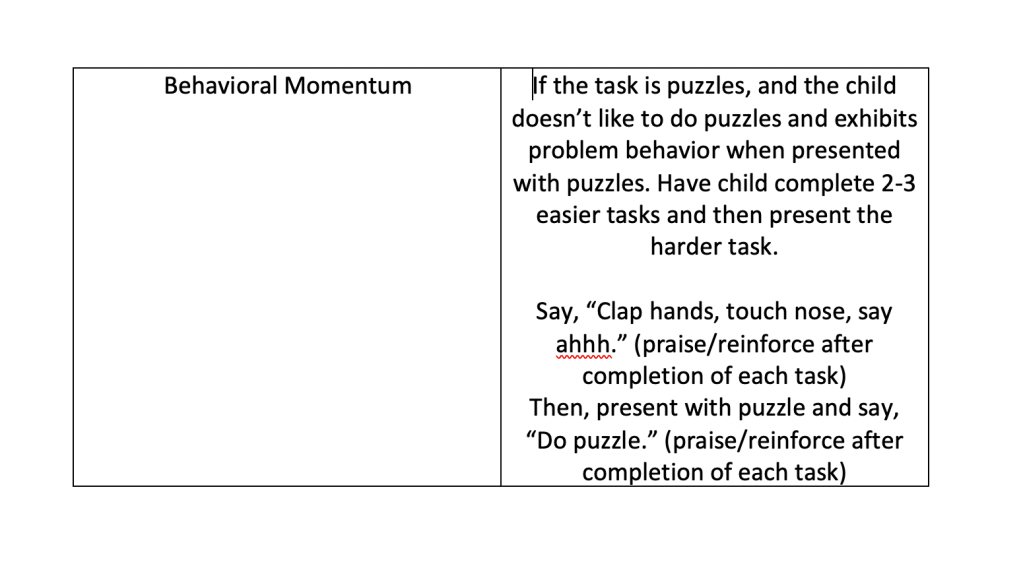
Hello First Coffee Then ABA Family!!!! I am super excited to share one of my favorite behavior compliance interventions!!! I have used this intervention so much!! I have used it with very young children as well as middle and high school children!! This intervention is very effective no matter the level of functioning!!! This intervention is called behavioral momentum!! I know…the name sounds big and scary, but I promise it is easy peasy!!! So, what in the world is behavioral momentum you ask? Well, it is a fancy term for having a child complete easier, more preferred tasks prior to asking them to do a harder, less preferred task that they are likely to try to escape from. So, let me give you an example. If your child or student does not like to do puzzles and tries to escape from doing puzzles every time you present them, then you could have them perform 2-3 easy, previously mastered, or more preferred tasks prior to asking him/her to put in a puzzle piece. So, I might ask my child to clap hands, touch nose, say “ahhh”, then ask my child to put the puzzle piece in. So, you might ask, why or how does this work? Well, you are using the momentum that they have built up while being successful at completing the easier tasks to keep them going to complete the harder task. You might have to do this for every puzzle piece, or the child might be able to complete several puzzle pieces before needing to build up momentum again. Be sure that you are praising the child and providing reinforcement for doing the easier tasks and also for completing each part the harder task. Providing the praise or another type of reinforcement for completing the tasks helps the child build the momentum and helps prevent the child from exhibiting problem behavior and trying to escape from the harder task. Behavioral momentum really is that simple, and it really does work!! Here are a few keys to success: make sure the tasks that you ask the child to do before the harder task really are easier skills for the child, make it fun and be excited, the easier tasks should also be quick, be sure to praise and/or reinforce the child for completing the tasks, and be willing to let the child build momentum again if needed to complete the task. The more successful the child is with the harder task; the more willing the child will be to engage in that task without exhibiting problem behavior in the future!!! I hope that you find this intervention useful for child/student/client!!! Don’t forget to share our page so that we can help as many families and professionals as possible!!! When we reach 100 likes, I will be giving away 2 gift cards!!! With Love, Kimberly W.

 First Coffee Then ABA